tech
AI Workplace Design 2026: The Human-Centric Office
31 October 2026 · 6 min read
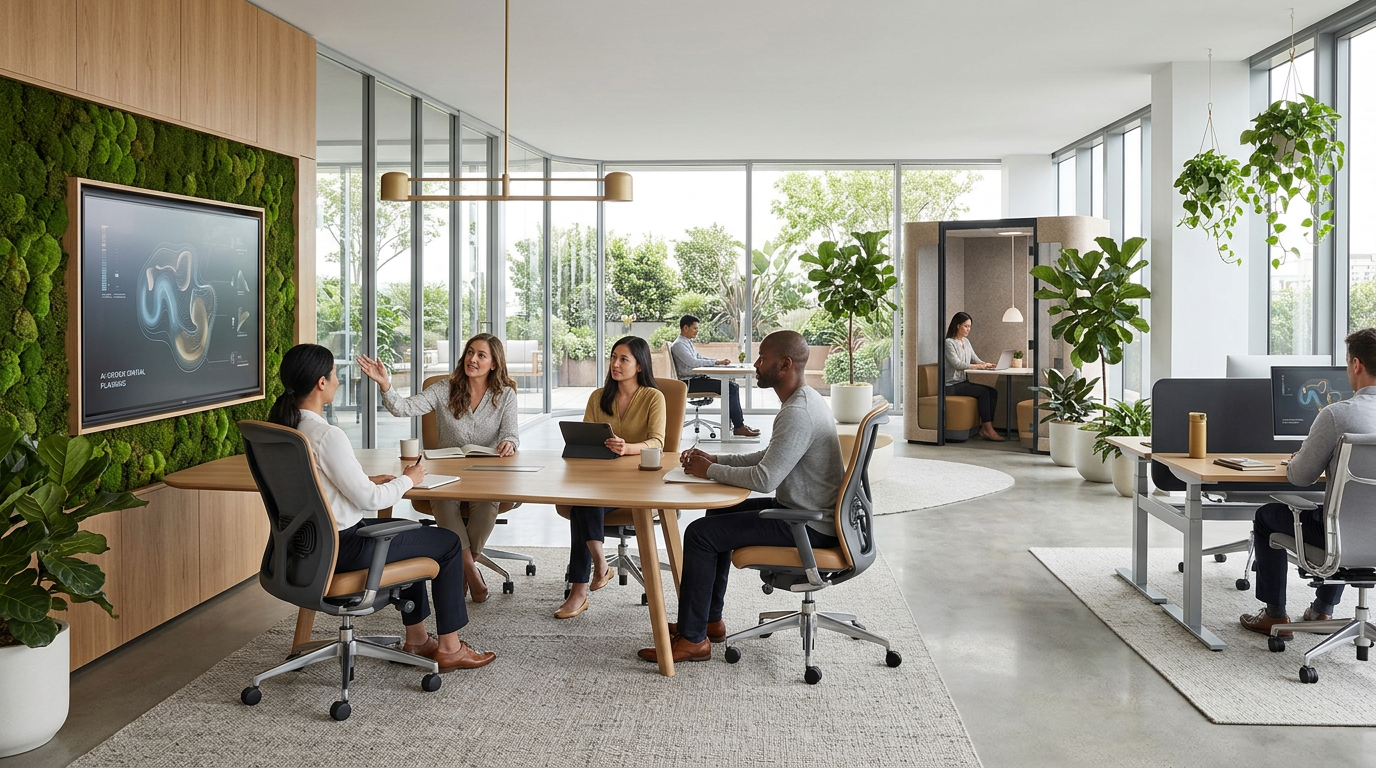
Modern corporate leaders face a critical paradox: workplace technologies have advanced exponentially, yet employee burnout and spatial disengagement remain at an all-time high. In 2026, the corporate office is no longer merely a place to complete operational tasks; it is a collaborative sanctuary that must actively support cognitive health, emotional balance, and purposeful collaboration.
AI workplace design 2026 leverages real-time occupancy data, generative spatial modeling, and environmental sensors to create adaptive workspaces that prioritize human physical and mental wellbeing. Rather than reducing floor space for mere cost-cutting, forward-thinking organizations use artificial intelligence to craft responsive environments that enhance focus, support neurodiversity, and cultivate meaningful team connection.
1. The Strategic Shift in AI Workplace Design 2026
The physical workplace has reached a turning point where static layouts can no longer meet the dynamic expectations of modern teams. Traditional floorplans relied on rigid departmental silos and fixed desk allocations, resulting in underutilized square footage and uninspiring atmospheres. By integrating machine intelligence into spatial strategy, leaders can now anticipate behavioral patterns rather than react to them.
Deploying algorithmic space planning allows facilities directors to evaluate thousands of layout permutations in seconds. Instead of making subjective guesses about desk counts, spatial models evaluate foot traffic, acoustic disruption, and department adjacencies. This shift fundamentally redefines our understanding of workplace design solutions, converting physical offices from passive containers into responsive, supportive ecosystems.
When computational tools analyze environmental metrics—such as CO₂ levels, natural light penetration, and reverberation rates—they help design teams allocate zones tailored to specific neurological needs. Focus corridors, social hubs, and restorative niches are distributed according to actual human workflow rhythms rather than outdated corporate formulas.
2. Smart Office Layout Optimization and Hybrid Dynamics
Designing for the hybrid reality requires more than booking software; it demands continuous spatial iteration based on verified usage patterns. Smart office layout engineering utilizes anonymized heat maps, presence sensors, and calendar telemetry to discern how teams truly interact.
By analyzing real-time data, systems determine whether employees gather for focused co-creation, informal mentoring, or confidential problem-solving. This visibility enables organizations to dynamically convert vacant cubicle rows into agile workshops or calm library spaces. Exploring our foundational approach to a human-centered workplace philosophy reveals that technology should serve comfort and creativity above all else.
Key spatial advantages of this data-informed methodology include:
- Predictive resource allocation: Aligning cafeteria capacity, meeting pods, and air circulation with projected daily attendance.
- Frictionless collaboration: Grouping complementary project teams based on active cross-functional initiatives rather than rigid organizational charts.
- Ergonomic adaptation: Recommending desk heights, micro-break pauses, and posture transitions based on movement analysis.
3. Biophilic Design AI: Elevating Employee Wellbeing Tech
The physical environment exerts an immense biological influence on human recovery and focus. Biophilic design AI bridges modern cognitive science and interior architecture by calibrating living systems to internal circadian rhythms. Environmental algorithms regulate full-spectrum lighting to simulate natural sun movement, sustaining natural energy levels throughout the workday while reducing eye strain.
Integrated environmental controls continuously refine airflow, ambient moisture, and thermal comfort across distinct spatial sectors. When integrated with employee wellbeing tech, these systems identify indoor air stagnation before it impairs cognitive performance. In parallel, dynamic acoustic masking creates subtle, restorative background soundscapes—such as gentle flowing water or rustling leaves—in high-stress zones.
This biophilic integration proves that advanced algorithms and living nature are natural partners. By creating pockets of living greenery, natural daylight access, and acoustic buffers, directors foster an environment where people feel restored rather than drained at the conclusion of a work session.
4. Hybrid Workspace Optimization and Behavioral Architecture
Achieving effective hybrid workspace optimization requires balancing individual autonomy with collective identity. If team members commute to an office merely to sit on remote video calls behind a partition, the physical office loses its reason for being.
Artificial intelligence aids directors in orchestrating moments of intentional proximity. When multidisciplinary team members plan in-office days, spatial tools can configure collaborative studios equipped with adaptive whiteboards, acoustic boundaries, and ergonomic seating.
By examining behavioral data, leaders can identify indicators of spatial friction—such as consistently overcrowded focus booths or desolate social lounges—and swiftly adapt the interior topography. For deeper guidance on responsible technical integration, examining ethical AI practices for business ensures organizational transparency remains uncompromised.
5. Protecting Privacy and Agency in Algorithmic Workspaces
The transition to sensor-informed facilities raises justifiable concerns regarding continuous surveillance. Sustainable workplace transformation relies entirely on trust; the moment employees feel monitored rather than supported, engagement declines rapidly.
Directors must implement strict data governance:
- Aggregated anonymity: Collecting strictly macro-level spatial trends rather than tracking individual workstation habits.
- Clear opt-in protocols: Providing complete clarity regarding which sensors operate within common areas.
- Human-in-the-loop governance: Ensuring workplace directors and staff committees retain final veto power over any structural or policy changes proposed by automated models.
When applied with dignity and transparency, spatial intelligence empowers employees by removing daily operational friction, letting them focus entirely on meaningful, creative achievements.
- Treating spatial data purely as a real-estate cost reduction exercise instead of a lever for human creativity and team cohesion.
- Deploying individualized tracking mechanisms that undermine psychological safety and destroy workplace culture.
- Neglecting qualitative employee feedback while relying solely on quantitative machine-generated spatial analytics.
- Audit current office utilization rates using anonymized environmental sensors to establish an accurate baseline of actual space usage.
- Identify acoustic bottlenecks and collaborative friction points across existing floorplans through direct employee sentiment workshops.
- Pilot a dynamic, multi-zone micro-hub integrating circadian lighting, modular furniture, and biophilic elements in a single department wing.
- Establish an ethical spatial data charter guaranteeing employee anonymity before expanding facility-wide algorithmic analysis.
- Gensler Research Institute | https://www.gensler.com/gri
- International WELL Building Institute | https://www.wellcertified.com
- Leesman Index | https://www.leesmanindex.com
What is AI workplace design 2026?
It is an architectural and strategic discipline that uses predictive analytics, machine learning, and environmental sensors to plan, design, and manage corporate workplaces centered on human performance and wellbeing.
How does smart office layout technology protect employee privacy?
Professional systems utilize privacy-by-design principles, using thermal imaging, optical density counters, or aggregated presence sensors that do not capture personal identities, keystrokes, or facial recognition data.
Can biophilic design combined with AI tangibly improve productivity?
Yes. Empirical studies indicate that biophilic interventions—such as circadian daylight tuning, living greenery, and dynamic acoustic masking—significantly lower cortisol levels, diminish mental fatigue, and improve focus across intensive tasks.