tech
Sustainable Office Tech 2026: Hitting Net-Zero
4 November 2026 · 6 min read
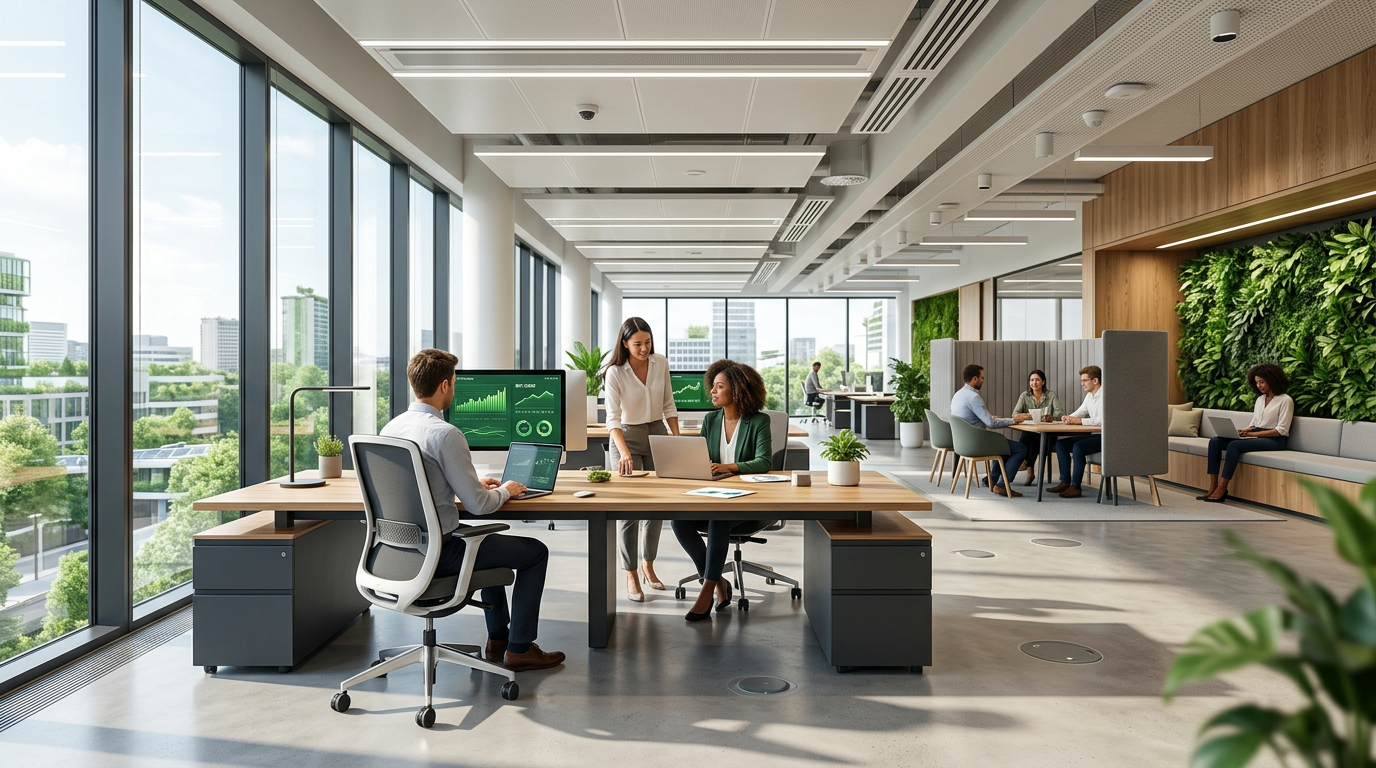
Corporate real estate is undergoing an unprecedented structural reset. Today, achieving corporate climate targets requires moving past passive compliance and embedding responsive intelligence directly into workplace ecosystems. For directors, the challenge is clear: build spaces that drastically lower environmental footprints while elevating everyday human well-being.
Sustainable office tech 2026 combines predictive artificial intelligence, real-time IoT spatial analytics, and circular resources to eliminate commercial real estate emissions. By aligning HVAC and lighting dynamically with verified employee occupancy, organizations cut baseline energy usage by up to 35% while extending furniture and asset lifecycles through closed-loop procurement.
1. The Operational Shift to Sustainable Office Tech 2026
For commercial leadership, decarbonization has moved from high-level corporate social responsibility reporting directly into executive real estate strategy. Today's building directives mandate measurable emissions reductions across both operational activities and embodied materials. Simply purchasing energy offsets is no longer sufficient to satisfy enterprise stakeholders, regulatory boards, or incoming talent.
Modern enterprises are actively adopting sustainable office tech 2026 frameworks that treat physical premises as living, breathing networks. The goal is no longer just maintaining a passive office, but operating an adaptive environment where energy consumption responds in real time to actual human presence. Exploring contemporary AI workplace design 2026 demonstrates that workplace efficiency must remain intimately connected to employee comfort rather than mechanical cost-cutting.
The Role of Predictive Spatial Intelligence
Traditional building automation relies on static timers that heat, cool, and illuminate empty corridors. In contrast, modern spaces deploy localized sensing to anticipate demand based on team schedules, regional weather inputs, and historical room utility.
2. Dynamic AI Energy Optimization in the Built Environment
Heating, ventilation, and air conditioning (HVAC) systems account for roughly 40% of standard commercial office energy use. Mitigating this footprint requires deep, predictive infrastructure management rather than periodic manual interventions.
By leveraging AI energy optimization, building control systems process telemetry from micro-sensors across floor plates. Rather than running continuously at full capacity:
- Air handlers calibrate airflow dynamically based on real-time CO2 saturation and thermal load.
- Zoned thermal controls adjust temperature according to confirmed workstation reservations.
- Smart window glazing modulates solar gain throughout peak midday hours to lower mechanical chiller strain.
These operational shifts preserve comfortable ambient working conditions while eradicating unnecessary nocturnal and low-density energy waste. Applying structured Design Thinking for AI integration ensures that these systemic controls remain intuitive for operations teams and non-intrusive for the staff working beneath them.
3. Engineering the Eco-Friendly Smart Building Infrastructure
Decarbonization relies heavily on holistic spatial awareness. An eco-friendly smart building uses anonymized occupancy telemetry to map how hybrid teams inhabit space across varying days of the week.
When Thursday occupancy peaks while Friday operates at 20% capacity, smart management software consolidates active operations onto specific floors. Entire zones, executive wings, and peripheral cafeterias transition into low-energy stand-by states. This spatial rationalization directly limits auxiliary energy loads—including localized lighting, secondary server closets, and terminal hot water circulation—generating immediate utility reductions without disrupting team workflows.
Furthermore, integrating real-time carbon telemetry into enterprise dashboards provides facilities directors with audit-grade data, directly simplifying Scope 1 and Scope 2 compliance disclosures.
4. Closing the Loop: Circular Office Furniture and Material Integrity
Energy management addresses only one side of the net-zero equation; embodied carbon within physical assets represents an equally significant footprint. Interior fit-outs traditionally contribute substantial landfill waste every five to seven years during routine lease terminations or corporate restructurings.
Transitioning to high-performance green workplace solutions demands rigorous procurement standards:
- Modular Construction: Architectural wall partitions and acoustic baffles designed for rapid demountability and re-assembly in future layouts.
- Asset-as-a-Service: Sourcing ergonomic seating and workstations through take-back guarantees, ensuring manufacturers reclaim and re-manufacture components at end-of-use.
- Bio-based and Recycled Substrates: Selecting textiles, sound-dampening felt, and tabletop surfaces derived from agricultural waste, certified post-consumer polymers, or verified regenerative sources.
Investing in circular office furniture fundamentally lowers embodied carbon while preserving capital flexibility. Utilizing targeted office design services allows companies to construct adaptable spaces using durable, non-toxic materials that protect indoor environmental health over decades of sustained use.
5. Prioritizing Human Health in the Net-Zero Office
An office cannot be considered genuinely sustainable if it achieves thermal efficiency at the expense of its occupants. True eco-intelligence prioritizes the physiological and psychological well-being of the workforce above all else.
Elevated carbon dioxide levels in poorly ventilated conference rooms diminish cognitive output, executive decision-making, and focus. Responsive air purification systems counter this by introducing balanced volumes of outdoor air only when needed, maintaining fresh indoor environments while avoiding unneeded conditioning runs. Combined with biodynamic lighting that matches natural circadian rhythms and acoustic zones engineered using renewable acoustic felt, the sustainable office becomes an asset for individual vitality and enterprise longevity.
- Over-automating environmental controls without providing localized manual overrides, causing employee discomfort and frustration.
- Focusing exclusively on operational electricity while ignoring the massive embodied carbon embedded within cheap, non-recyclable interior furniture.
- Deploying fragmented point technologies (isolated apps, standalone sensors) that fail to communicate with central building management platforms.
- Sacrificing employee air changes and thermal comfort merely to satisfy narrow, numeric kilowatt reduction goals.
- Conduct an operational and embodied carbon audit across your existing workplace real estate to identify major structural inefficiencies.
- Pilot occupant-responsive environmental sensors across high-traffic collaboration zones to assess HVAC and lighting consumption variance.
- Transition interior procurement policies to strict circular standards, mandating modular assemblies and buy-back guarantees for upcoming refreshes.
- Integrate real-time environmental telemetry into workplace operations to continuously balance energy conservation with indoor environmental wellness.
- International Energy Agency | https://www.iea.org
- World Green Building Council | https://worldgbc.org
- U.S. Green Building Council | https://www.usgbc.org
How does sustainable office tech reduce operating expenses for commercial tenants?
By integrating occupancy sensors and predictive artificial intelligence, commercial facilities eliminate the conditioning and illumination of underutilized zones, leading to documented reductions of 20% to 35% on baseline utility expenditures.
What defines circular office furniture in a modern corporate setting?
Circular furniture incorporates modular, non-toxic components manufactured from recycled or renewable materials, supported by end-of-life take-back frameworks that prevent workplace assets from entering landfill waste streams.
Can older commercial buildings be retrofitted with smart eco-technologies?
Yes. Modern IoT environmental sensors, wireless cloud gateways, and smart thermostatic valves deploy without disruptive structural renovations, interfacing seamlessly with legacy building management systems to achieve substantial operational savings.